
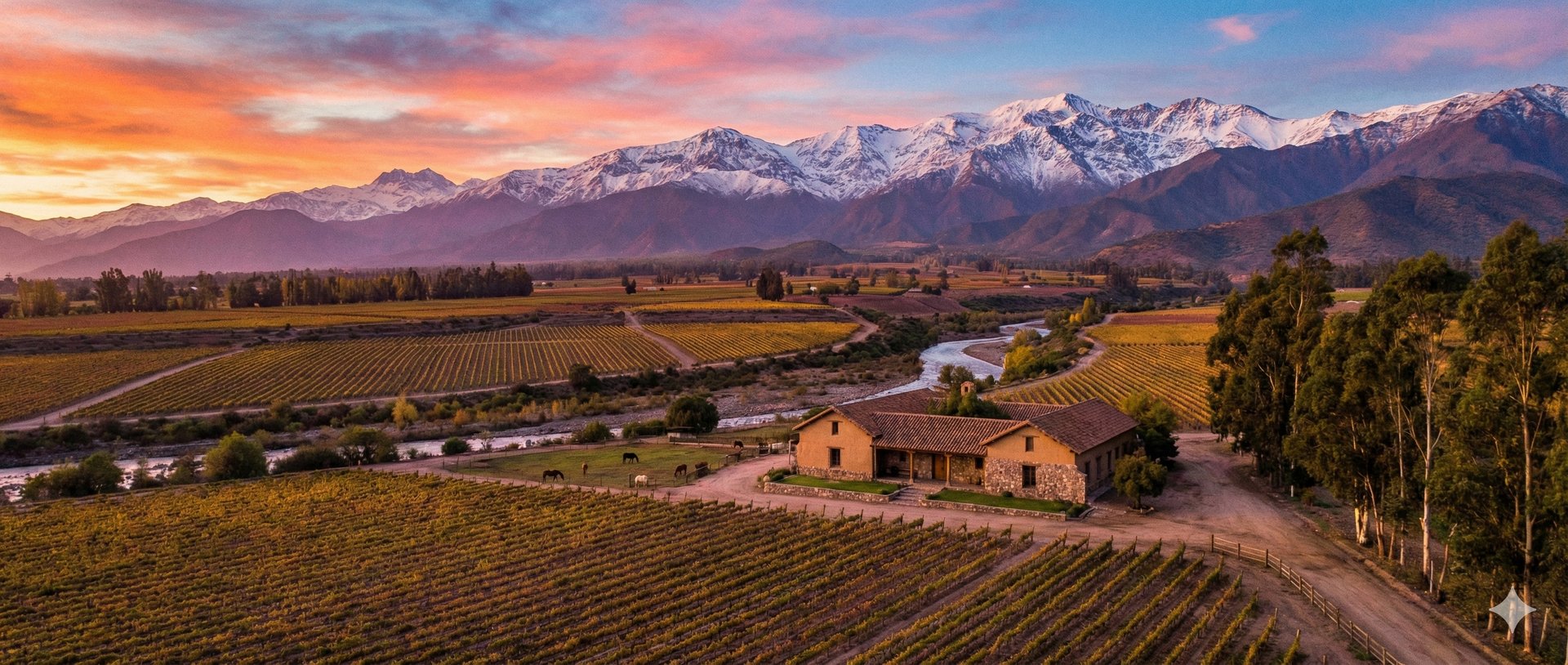
Chile: The Viticultural Paradise at the Edge of the World
Why Geography Matters: Ungrafted Vines and the Rediscovery of Carmenère
12/11/20253 min read
If you look at a map, Chile looks like a long, thin ribbon stretching along the coast. But for a winemaker, Chile looks like a fortress.
Bounded by the Andes Mountains to the east, the Pacific Ocean to the west, the Atacama Desert to the north, and glaciers to the south, Chile is isolated from the rest of the world. This isolation creates a perfect, healthy environment for grapes. Known for incredible consistency and reliability, Chile has moved beyond "cheap and cheerful" wines to produce world-class reds that rival the best of Napa and Bordeaux.
A Sip of History: The Phylloxera Miracle
Chile holds a unique distinction in the wine world: it is the only major wine country that was never hit by Phylloxera.
In the late 1800s, a tiny root-eating louse (Phylloxera) nearly destroyed all the vineyards in Europe. To survive, European vines had to be grafted onto resistant American rootstocks. However, thanks to Chile's natural barriers, the louse never made it there.
Why does this matter?
It means that in Chile, many vines grow on their own natural roots (ungrafted). Many experts believe this results in healthier, longer-living vines and a purer expression of the fruit.
The Detective Story: The Case of the Carmenère
For decades, Chilean winemakers thought they were growing a unique, spicy type of Merlot. It wasn't until 1994 that a French ampelographer (a grape scientist) visited Chile and made a shocking discovery.
The grape wasn't Merlot at all. It was Carmenère, a classic Bordeaux grape that was thought to be extinct since the phylloxera outbreak in France! Chile had accidentally preserved this lost variety. Today, Carmenère is Chile’s signature grape, offering a spicy, savory alternative to Cabernet.
Major Wine Regions: From Mountains to Ocean
Because Chile is so long, the climate changes drastically from North to South, but the biggest influence is usually East (Mountains) vs. West (Ocean).
1. Maipo Valley
Located right next to Santiago, this is the historic heart of Chilean wine. It is often called the "Bordeaux of South America."
The Style: Famous for rich, minty, and structured Cabernet Sauvignon.
2. Colchagua Valley
Located to the south of Maipo. It is warmer and produces ripe, powerful reds.
The Style: This is the home of the best Carmenère and full-bodied Syrah.
3. Casablanca Valley & Leyda Valley
These are cool-climate regions located very close to the Pacific Ocean. The cold ocean fog (the Humboldt Current) keeps the grapes cool.
The Style: Crisp, zesty Sauvignon Blanc, fresh Chardonnay, and elegant Pinot Noir.
The Grapes: The King and The Lost Prince
While Chile grows almost everything, red wines dominate the landscape.
Top Red Grapes
Cabernet Sauvignon: The undisputed King. It covers the most land and produces the highest quality wines, known for notes of blackcurrant, eucalyptus, and green pepper.
Carmenère: The signature grape. It has soft tannins and distinct flavors of red berries, black pepper, and sometimes a herbal "green" note that divides critics.
Merlot: Friendly, soft, and fruity.
Top White Grapes
Sauvignon Blanc: Chilean Sauvignon Blanc is incredible. It is extremely aromatic, bursting with lime, grapefruit, and tropical fruit flavors.
Chardonnay: Ranges from crisp and mineral (coastal) to rich and oaky (inland).
Production Statistics
Chile is an export powerhouse. According to recent data from the OIV:
Global Rank: Chile is typically the #6 or #7 largest wine producer in the world.
Volume: Producing around 11 to 12 million hectoliters annually.
Export Focus: Unlike Argentina or the US, Chile exports the vast majority of its wine (over 70%). You can find Chilean wine in almost every supermarket on the planet.
Renowned Producers and Wineries
Chile has a mix of massive corporate wineries and boutique, terroir-driven projects.
Concha y Toro: The giant. One of the largest wine companies in the world, famous for the ubiquitous "Casillero del Diablo" but also for high-end luxury wines.
Montes: A pioneer in quality. Aurelio Montes was one of the first to focus on export-quality premium wines with his "Montes Alpha" line.
Lapostolle: Founded by the French family behind Grand Marnier. They brought French expertise to Chilean terroir.
Errazuriz: A historic family winery that constantly beats top French wines in blind tastings (The "Berlin Tasting").
Viu Manent: A specialist in Malbec and old vines in the Colchagua Valley.
Iconic Wines: The Legends
If you want to taste the absolute best of Chile, these are the investment-grade bottles:
1. Almaviva
A partnership between Concha y Toro and Baron Philippe de Rothschild (of Château Mouton Rothschild). It is a Bordeaux-style blend that is arguably the most famous wine in South America.
2. Don Melchor (Concha y Toro)
A single-vineyard Cabernet Sauvignon from the Maipo Valley. It consistently ranks among the best Cabernets in the world.
3. Clos Apalta (Lapostolle)
A Carmenère-dominant blend that was once named the #1 Wine of the Year by Wine Spectator. It is lush, powerful, and hedonistic.
Conclusion: Incredible Value, Incredible Quality
For a long time, Chile was the place to go for a $10 bottle of good wine. That is still true, but today, Chile offers so much more. From the crisp whites of the coast to the world-class Cabernets of the Andes foothills, Chile proves that you don't need to spend a fortune to drink like a king. Next time you want a red, try a Carmenère and taste a piece of history!