Italy: The Land of a Thousand Grapes
Decoding the Label: Classico, Riserva, and the Super Tuscan Revolution
12/11/20254 min read
Benvenuto to Italy! The ancient Greeks nicknamed this land "Oenotria," which literally means the "Land of Wine." They weren't wrong. In Italy, wine is not just a drink; it is food, it is culture, and it is a way of life.
From the snowy Alps in the north to the sun-drenched islands of the south, vines grow everywhere. Italy is famous for its incredible diversity. While other countries rely on a handful of grapes, Italy boasts hundreds (some say thousands) of native varieties that grow nowhere else. It is a chaotic, beautiful, and delicious puzzle waiting to be solved.
A Sip of History: Ancient Roots and Modern Rebellion
Italy has been making wine for over 4,000 years. The Romans took winemaking to an industrial scale, spreading vines across Europe. But the most interesting part of Italian wine history happened much more recently.
In the 1970s, a group of winemakers in Tuscany decided they were tired of strict, outdated laws that forced them to make mediocre wine. They broke the rules, blending Italian grapes with French grapes like Cabernet Sauvignon. These outlaw wines became known as the "Super Tuscans." They were so good that they changed Italian wine laws forever, proving that quality matters more than tradition.
Decoding the Label: Classico, Riserva, and Super Tuscans
Italian labels can be tricky. Here is a cheat sheet for the most common terms you will see:
DOCG and DOC
These are the official quality categories (similar to the French AOC).
DOCG: The highest guarantee of quality. These wines are tested by a government committee.
DOC: The standard tier for quality wines from a specific region.
Classico
You will often see "Chianti Classico." This means the grapes were grown in the original, historic center of the region, which is usually considered the best terrain.
Riserva
This means the wine was aged longer than the standard version (usually in oak barrels) before being released. It implies higher quality and a bolder taste.
IGT (Indicazione Geografica Tipica)
Originally created for those rebellious "Super Tuscans." These wines might not follow traditional regional recipes, but they can be some of the most expensive and high-quality bottles in the country.
Major Wine Regions: The Big Three (and a Rising Star)
Italy has 20 regions, and all of them make wine. However, these are the heavyweights:
1. Tuscany (Toscana)
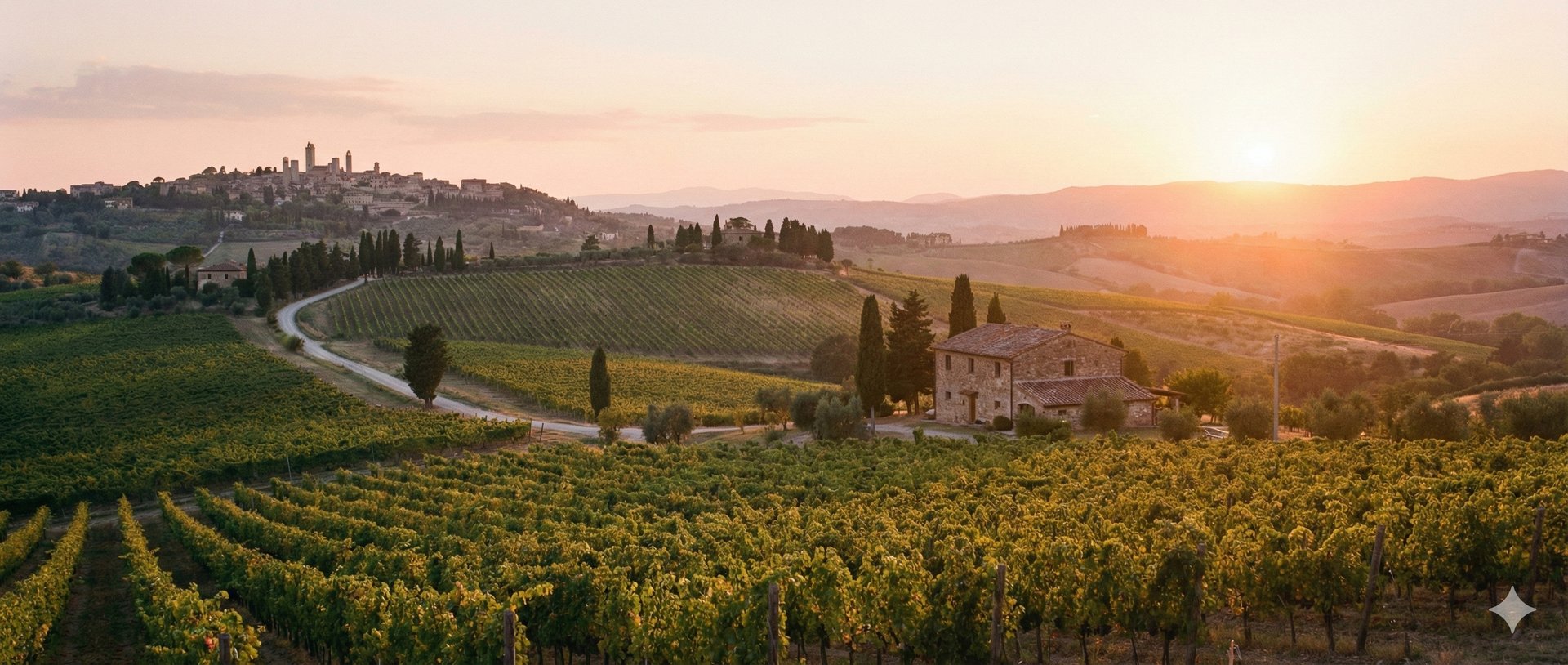
The most famous region, located in central Italy. Think rolling hills and cypress trees.
The Grapes: Sangiovese is King.
Famous Wines: Chianti Classico (earthy and tart), Brunello di Montalcino (powerful and age-worthy), and the Super Tuscan blends.
2. Piedmont (Piemonte)
Located in the northwest, at the foot of the Alps. It is often compared to Burgundy because it focuses on single varietals and elegance.
The Grapes: Nebbiolo.
Famous Wines: Barolo and Barbaresco. These are known as the "King and Queen" of Italian wines—pale in color but incredibly high in tannins and acidity.
3. Veneto
In the northeast (near Venice). This is a powerhouse of volume and variety.
The Grapes: Glera and Corvina.
Famous Wines: Prosecco (the world's most popular sparkling wine) and Amarone (a rich, high-alcohol red wine made from dried raisins).
4. Sicily (Sicilia)
The rising star of the south. Once known for bulk wine, Sicily is now producing exciting volcanic wines around Mount Etna.
The Grapes: Nero d'Avola (red) and Nerello Mascalese (volcanic red).
The Grapes: A Dizzying Variety
Italy has more native grape varieties than any other country. Here are the essential ones:
Top Red Grapes
Sangiovese: The backbone of Tuscany. Flavors of sour cherry, dried herbs, and tomato leaf. High acidity makes it perfect for pizza and pasta.
Nebbiolo: The star of Piedmont. It smells like roses and tar but has massive tannins that dry your mouth.
Barbera: The "people's wine" of the north. Juicy, low tannin, and very easy to drink.
Primitivo: Found in the south (Puglia). It is genetically identical to Zinfandel.
Top White Grapes
Pinot Grigio: Famous worldwide for being crisp, dry, and refreshing.
Glera: The grape used to make Prosecco.
Trebbiano: The workhorse white grape used in many blends.
Production Statistics
Italy is a giant. According to the OIV (International Organisation of Vine and Wine) recent data:
Global Rank: Italy is consistently the #1 largest producer of wine in the world by volume, frequently swapping places with France depending on the harvest.
Volume: Producing approximately 45 to 50 million hectoliters annually.
Export: Italy is the largest exporter of wine by volume. The world drinks more Italian wine than any other!
Renowned Producers and Wineries
Italian wine involves huge families and centuries of lineage.
Marchesi Antinori (Tuscany): One of the oldest companies in the world (making wine since 1385!). They were pioneers of the Super Tuscan movement with their wine "Tignanello."
Gaja (Piedmont): Angelo Gaja is credited with modernizing Piedmont and putting Barbaresco on the world map.
Tenuta San Guido (Tuscany): The producer of "Sassicaia," the very first Super Tuscan wine that beat French wines in blind tastings.
Biondi-Santi (Tuscany): The inventors of Brunello di Montalcino. Traditional and legendary.
Iconic Wines: La Dolce Vita in a Bottle
1. Sassicaia (Tenuta San Guido)
The wine that started a revolution. It is a Cabernet Sauvignon blend from the coast of Tuscany. It remains one of the most sought-after wines in the world.
2. Tignanello (Antinori)
The first Sangiovese to be aged in new French oak barrels and blended with international varieties. A milestone in Italian winemaking history.
3. Barolo Monfortino (Giacomo Conterno)
A legendary, ultra-traditional wine from Piedmont. It is only made in the best years and is aged for a very long time in large casks.
Conclusion: Eat, Pray, Drink
Italian wine is designed for the dinner table. It usually has high acidity, which acts as a palate cleanser for rich foods. Whether you are popping a cork of Prosecco for an aperitivo or sharing a rustic Chianti with friends, Italian wine invites you to enjoy the moment. Buon appetito!