Decoding the Bordeaux Blend
WINEMAKING
3/26/20263 min read
How six grape varieties found a perfect rhythm in France—and became a global sensation.
Imagine trying to bake the world's most complex, delicious chocolate cake, but the climate is so unpredictable that one year your flour is amazing but your cocoa powder fails, and the next year, it's the opposite. If you committed to only using one ingredient, your cake would be inconsistent.
This is the exact challenge winemakers in Bordeaux, France, faced centuries ago.
They needed a way to guarantee quality every year, despite the fickle maritime weather. Their solution? The ultimate insurance policy: blending. They realized that by growing different grape varieties that ripened at different times and brought different "flavors" to the table, they could always create a balanced, complex wine, regardless of what Mother Nature threw at them.
Today, this strategy has evolved into "the Bordeaux blend," a blueprint for greatness that has been adopted by winemakers from Napa Valley to South Australia. It is the sophisticated art of finding balance, not in a single vineyard, but in the harmony of multiple components.
Meet the All-Stars of the Blend
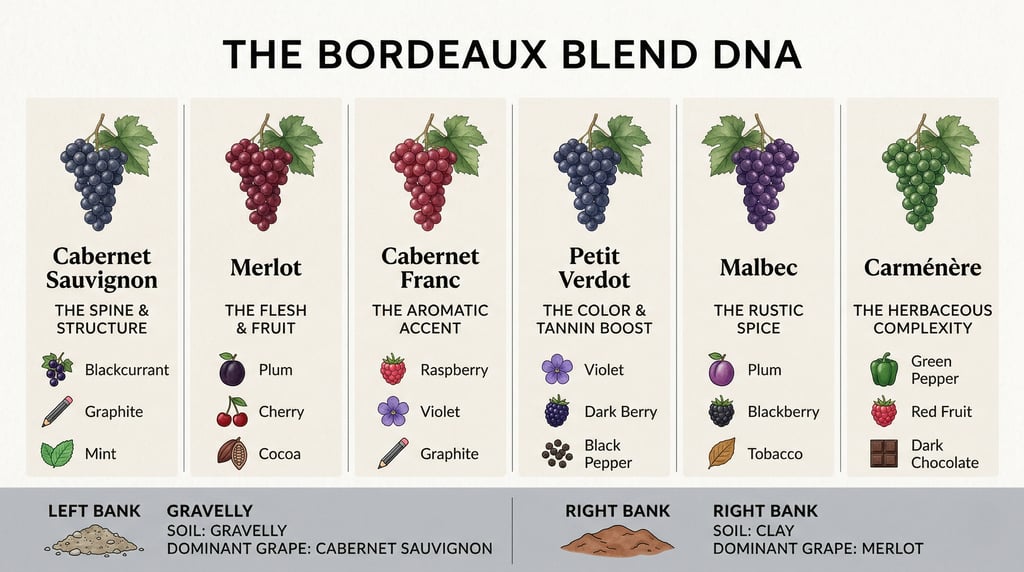
The Bordeaux blend isn't a random mix. It is traditionally limited to six specific red grape varieties. Think of them as members of an elite team, each with a specialized role.
1. Cabernet Sauvignon: The Structure and Spine This is the quarterback. "Cab" brings powerful tannins, a deep red color, and high acidity. It gives the wine its long-term aging potential. When you smell that classic blackcurrant (cassis), graphite, or cedar, you are smelling Cabernet Sauvignon.
2. Merlot: The Flesh and Fruit If Cabernet is the structure, Merlot is the soft upholstery. It is plummy, juicy, and has softer tannins. It ripens earlier, making it a great "insurance" grape if late-season rains ruin the Cabernet harvest. Merlot adds body and makes the blend approachable when young.
3. Cabernet Franc: The Perfume and Spice Often overlooked, "Cab Franc" is the aromatic wildcard. It provides bright red fruit notes (like raspberry) and, crucially, a distinct savory, peppery, or violet aroma that lifts the entire blend, adding complexity and elegance.
4. The Support Cast: Petit Verdot, Malbec, and Carménère These three are used sparingly, like seasoning in a sophisticated dish.
Petit Verdot: Adds intense color and stiff, rigid tannins. Used often in tiny percentages (like 1-3%) to provide "mid-palate weight."
Malbec: (Yes, originally French!) Offers deep color and plum flavor. It was once more popular but is rarely used in Bordeaux now.
Carménère: The "lost grape" of Bordeaux. Very rare today, known for its herbal and savory spice profile.
The Great Divide: Left Bank vs. Right Bank
The way these grapes are used changes depending on which side of the Gironde Estuary they are grown. This is where terroir meets strategy.
The Left Bank (Cabernet Is King)
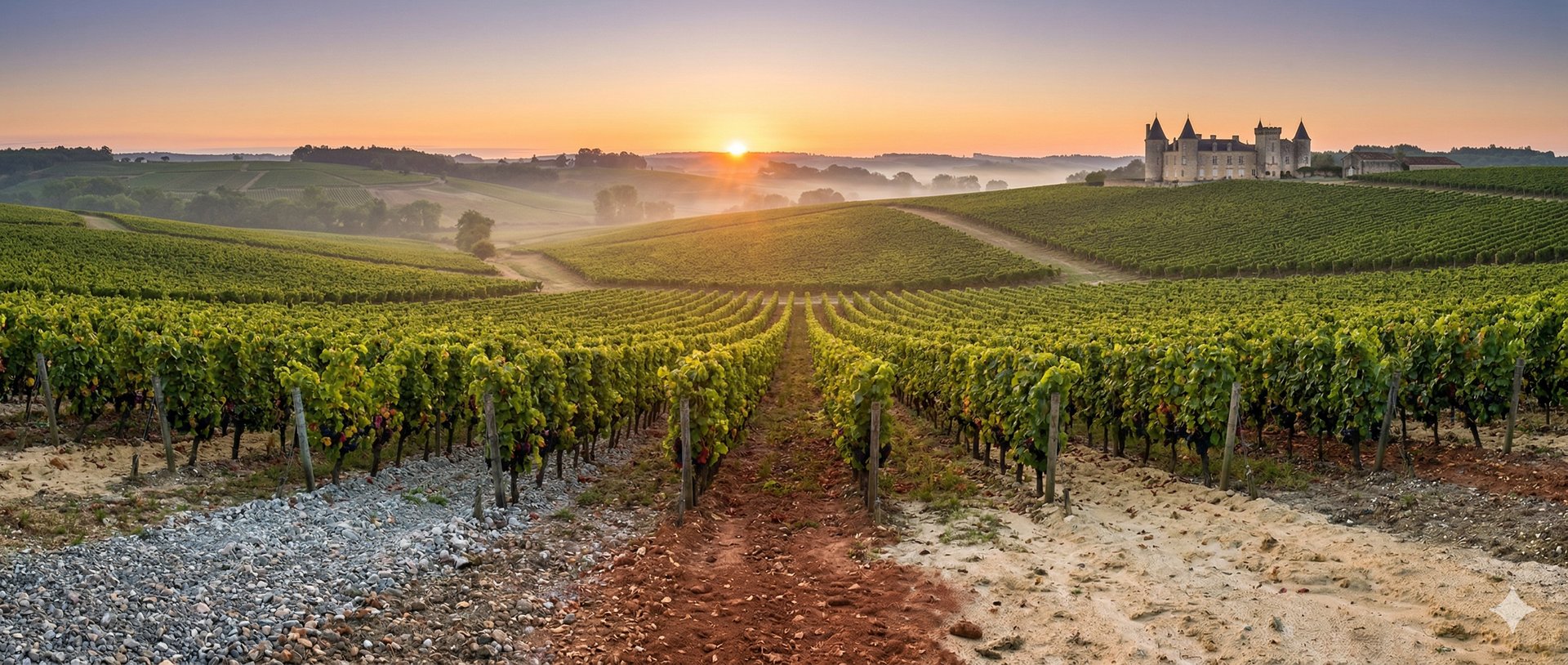
Regions like the Médoc and Graves are famous for their gravelly soils. Gravel drains exceptionally well and holds heat, which is perfect for the slow-ripening Cabernet Sauvignon.
The Vibe: Left Bank blends are Cabernet-dominant (often 70%+), structured, powerful, age-worthy, and often have those famous cedar and tobacco notes.
The Right Bank (Merlot Is Queen)
Regions like Saint-Émilion and Pomerol are defined by clay and limestone soils. Clay is cooler and holds more water—terrible for Cabernet, but a paradise for early-ripening Merlot.
The Vibe: Right Bank blends are Merlot-dominant, softer, juicier, more plummy, and are usually accessible to drink much sooner than their Left Bank cousins.
Why Do We Blend, Scientifically Speaking?
It isn't just about taste; there is science behind it.
Weather Mitigation: As mentioned, different grapes ripen at different times. If a frost hits early, you lose the early ripeners, but the late ones (like Cab) are safe. If a late storm hits, your early ripeners (like Merlot) are already fermenting safely in the tank.
Flavor Complexity: A single variety can be intense, but a blend offers a wider spectrum of aromas. While Cabernet Sauvignon gives you black fruit and structure, the addition of Cabernet Franc gives you floral, peppery notes, making the wine more multidimensional.
Structural Balance: High acidity must balance alcohol; high tannins must balance fruit. If the Cabernet is too lean and acidic, Merlot adds alcohol and body. If the Merlot is too soft and flabby, Cabernet Sauvignon provides the necessary spine and tannic grip.
The Global Blueprint
The success of the Bordeaux model was so absolute that it didn't stay in France. Winemakers worldwide realized that this specific combination of grapes (particularly Cab and Merlot) produced exceptionally complex, age-worthy, and, importantly, marketable wines.
Today, we see spectacular "Bordeaux-style" blends from:
Napa Valley, California: Famous for its powerful, lush, and high-quality Cabernet-led blends.
Tuscany, Italy (The "Super Tuscans"): Where local Sangiovese is often blended with Cabernet and Merlot to create modern masterpieces.
Stellenbosch, South Africa: Known for Cabernet-led blends that strike a balance between old-world structure and new-world fruit.
Margaret River, Australia: Producing elegant, maritime-influenced Cabernet-Merlot blends that rival Europe's finest.
Harmony in Diversity
When you look at a bottle that says "Bordeaux Blend" (or list those grape varieties), you are not just looking at a recipe. You are witnessing a history of adaptation, a commitment to quality insurance, and an artistic mastery of harmony. It is proof that sometimes, we are truly stronger together.